content
content
content
content
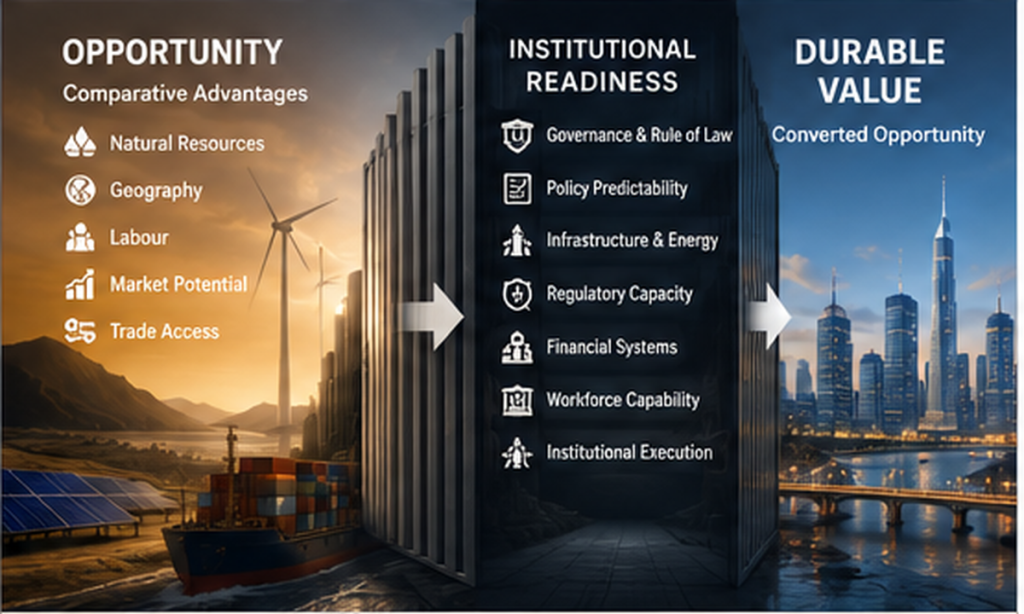
A country can have the resources, geography, labour, market size or strategic location that investors want and still fail to convert opportunity into durable value.
That distinction is becoming more important as global trade and investment networks are reconfigured. The WTO describes the emerging pattern as "re-globalization": not a retreat from international production, but a push toward deeper, more diversified and less concentrated networks. Yet recent evidence also shows that the benefits of this rewiring remain highly selective. Global foreign direct investment recovered in 2025, but more than 80% of it went to the world's top 20 host economies.
The implication is straightforward: comparative advantage can put a jurisdiction on the map. Institutional readiness determines what happens next.
Table of contents [Show]
- Globalization Is Being Rewired, Not Simply Reversed
- Investment Remains Highly Concentrated
- Comparative Advantage Gets You Considered. It Does Not Get You Executed.
- Attraction Is Not Absorption
- Absorption Is Not Execution
- Execution Is Not Conversion
- What Executives Should Examine Before Committing
- Readiness Is Decision-Specific
- The Executive Positioning Question
Globalization Is Being Rewired, Not Simply Reversed
Companies and governments have spent the past several years reassessing concentrated supply chains, geopolitical exposure and critical dependencies. WTO analysis describes global value chains as resilient but reconfiguring across geography, technology, industrial policy and environmental priorities.
That creates openings for locations that were previously peripheral to major production networks. But an opening is not the same thing as an investment outcome.
The WTO's own 2025 global-value-chain work noted that much of the recent rewiring had benefited economies that were already established suppliers. In other words, diversification may broaden the search, but investors still discriminate sharply among potential destinations.
Investment Remains Highly Concentrated
UNCTAD's World Investment Report 2026 shows why the distinction matters.
Global FDI rose 6% to US$1.6 trillion in 2025, but the recovery was uneven. Developed economies recorded stronger growth than developing economies, and the top 20 host economies captured more than 80% of global FDI.
The concentration is even more striking in strategic sectors. AI infrastructure, semiconductors, critical minerals and energy-transition technologies are absorbing a growing share of global greenfield investment. Strategic sectors accounted for 44% of global greenfield project values in 2025, up from 16% in 2020.
The world is looking for more resilience and more geographic options. Capital is not therefore becoming indiscriminate.
Comparative Advantage Gets You Considered. It Does Not Get You Executed.
Traditional opportunity narratives often begin with visible advantages: natural resources, labour availability, market size, geographic position, access to regional markets, tax incentives, or strategic relevance.
These factors matter. They can create the reason for an investor to look.
But they do not answer the questions that determine whether a project survives contact with reality:
- Is power reliable enough for the intended operation?
- Can goods move through ports, roads and borders predictably?
- Are permits and licences processed consistently?
- Can contracts and regulatory decisions be relied upon?
- Is the necessary workforce available and trainable?
- Can public and private counterparties execute at the required pace?
- Can the financial system support the transaction and operating model?
- Can policy changes be absorbed without destroying the investment case?
This is the institutional-readiness test.
Attraction Is Not Absorption
A jurisdiction can attract capital without being able to absorb it effectively.
Capital attraction asks whether the opportunity is compelling enough to draw interest or commitment. Capital absorption asks whether the receiving system can deploy that capital without being overwhelmed by infrastructure gaps, administrative friction, skills shortages or weak project execution.
The difference is easy to miss during the announcement stage. An investment memorandum, a government incentive, a project launch or a high-profile commitment can make a jurisdiction appear to be winning. The deeper test begins after the headline: whether financing closes, approvals arrive, infrastructure performs, contractors deliver, plants operate and customers are served.
Absorption Is Not Execution
Even when capital can enter a system, institutions still have to execute.
Execution is where many hidden constraints become visible: land, permitting, power, logistics, procurement, workforce, customs, local counterparties, project management and coordination across government agencies.
For executives, this is why country attractiveness should never be assessed only at the macro level. The practical question is whether the particular operating system around the proposed investment can function at the scale and reliability the business case assumes.
Execution Is Not Conversion
A completed project is still not the same thing as durable value.
UNCTAD emphasizes that the development contribution of FDI depends on whether investment builds productive capacity, jobs, skills and technology transfer. That is a conversion question.
A project may bring capital into a jurisdiction but create limited domestic capability. Another may strengthen suppliers, workforce skills, infrastructure, exports and institutional competence. The same amount of capital can therefore produce very different outcomes.
Capital attraction is an event. Capital conversion is an institutional capability.
What Executives Should Examine Before Committing
PRIPEX does not suggest that executives avoid imperfect markets. Frontier and emerging opportunities often exist precisely because institutions are still developing.
The objective is to distinguish known opportunity from unexamined execution risk.
Before a major market-entry, supply-chain, infrastructure or capital decision, executives should examine at least seven areas:
- Institutional credibility — can material rules, approvals and public commitments be relied upon?
- Policy predictability — can the investment case survive plausible policy change?
- Infrastructure and energy — are the physical and digital systems sufficient at operating scale?
- Regulatory capability — can permits, customs and administrative processes be completed consistently?
- Workforce capability — can the organization recruit, train and retain the people required?
- Trade and financial connectivity — can inputs, outputs and capital move efficiently?
- Execution capacity — can counterparties and institutions turn commitments into functioning assets?
These are not a country score. They are decision questions.
Readiness Is Decision-Specific
There is no single definition of readiness that applies equally to every investment.
A mine, a data centre, a logistics hub, a pharmaceutical plant and a digital-services operation require different institutional and infrastructure combinations. A jurisdiction can therefore be highly investable for one activity and poorly prepared for another.
That is why generic "best countries to invest in" rankings often provide less decision value than they appear to.
The relevant question is not whether a country is attractive in the abstract. It is whether the receiving system is ready for the decision you are actually considering.
The Executive Positioning Question
Re-globalization may create more options. It does not remove the need for discrimination.
For investors, boards and operating executives, the strategic sequence should therefore be: Identify the opportunity. Test the receiving system. Verify execution conditions. Then decide the level and timing of commitment.
The appropriate posture may be to engage, engage selectively, build optionality, require safeguards, monitor execution, delay commitment or reduce concentration.
PRIPEX's role is not to predict which jurisdiction will win the next wave of global investment. It is to help decision-makers ask the more useful question: which jurisdictions can actually convert the opportunities they appear to possess?
Positioning. Not prediction. Not forecast.
Are you considering a consequential cross-border market-entry, investment, supply-chain, infrastructure, partnership or jurisdiction-exposure decision where the opportunity looks stronger than the execution evidence? PRIPEX helps executives test the institutional assumptions before commitment.
Discuss the decision with PRIPEX →
Sources
World Trade Organization — re-globalization speeches and 2025 Global Value Chains report. UN Trade and Development (UNCTAD), World Investment Report 2026. UNCTAD, "Global investment rises 6% to $1.6 trillion, but development gains remain uneven," 7 July 2026. UNCTAD, "Investment in strategic sectors is expanding, but many developing economies risk being left behind," 9 July 2026. World Bank, Foreign Direct Investment in Retreat: Policies to Turn the Tide. WTO, Investment Facilitation for Development progress statement, 25 March 2026.
Decision support only. Not investment, legal, tax or regulated financial advice.