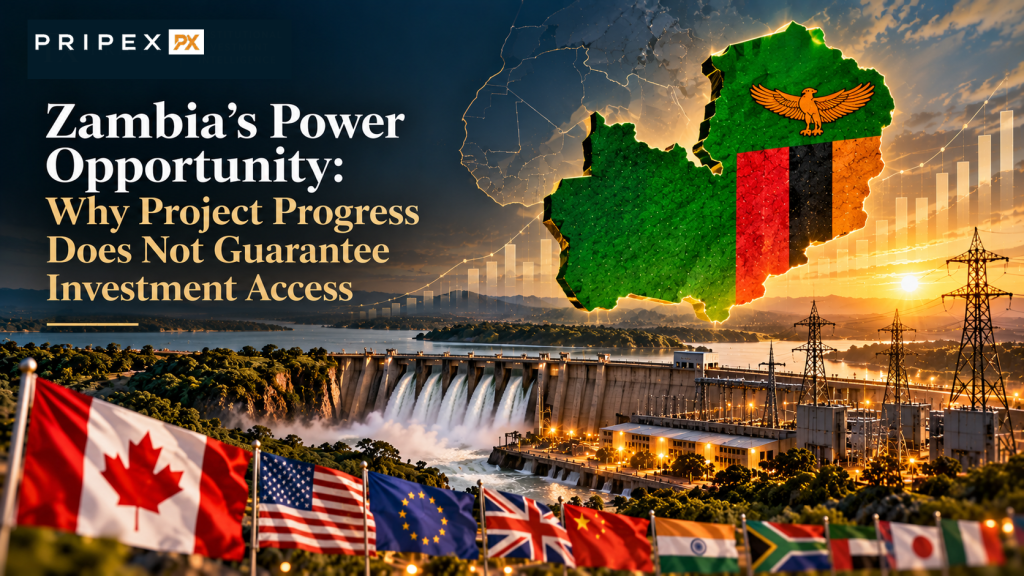
For Canadian institutions examining Zambia's energy sector, infrastructure demand is only the beginning of the investment question.
Zambia's electricity requirements and copper-sector ambitions create a substantial infrastructure challenge. For prospective investors, however, the existence of demand does not establish that a particular project requires capital—or that an accessible investment position exists.
The distinction becomes clearer when individual projects are examined through three separate tests: execution status, financing reality and transaction access.
Table of contents [Show]
Execution Status Is Not Transaction Access
Three Zambian power developments illustrate why an investor must distinguish infrastructure demand, project progress and the availability of a transaction.
Chisamba: An Outdated Construction Thesis
Chisamba's first 100 MW solar phase was commissioned in June 2025, followed by a second 100 MW phase in July 2026, bringing the complex to 200 MW.1
An assessment that continues to describe the first phase as partially constructed would therefore rely on an obsolete project snapshot.
For a prospective Canadian investor, the investment question has shifted from original construction funding to whether an identifiable refinancing, ownership transfer, expansion or other transaction is available.
The research has not established such an opening. Chisamba should not be treated as an actionable construction-investment opportunity on the basis of its earlier development status.
Before allocating resources, a Canadian investor would need to identify the current sponsor or owner, confirm that a transaction is being offered, and establish the instrument, approvals and due-diligence process required for participation.
Maamba: A Financing Structure Does Not Establish Investment Access
Maamba Energy's Phase II involves adding 300 MW to an existing 300 MW thermal-power plant, bringing planned total capacity to 600 MW.
ZCCM-IH has disclosed an estimated US$400 million project cost, comprising approximately US$300 million in consortium debt and US$100 million in shareholder equity.2
These disclosures provide a clearer financing picture than an assessment based solely on construction announcements.
For a prospective Canadian investor, the remaining question is whether an additional financing, refinancing, ownership or commercial participation opportunity actually exists. The disclosed project structure does not, by itself, establish one.
Any engagement must identify the current financing position, authorized counterparty and defined transaction before treating Maamba as an accessible investment opportunity.
A separate thermal-power development involving ZCCM-IH and Wonderful Group must not be confused with Maamba when assessing ownership or financing. For a Canadian investor, that distinction is material because attributing the other project's ownership or funding needs to Maamba could lead to pursuing the wrong counterparty or transaction.
First Quantum: Development Progress Is Not Financial Close
First Quantum's September 2025 power strategy identified a proposed 430 MW solar-and-wind programme, with power-purchase heads of terms signed.3
Chariot subsequently described its work with TotalEnergies on the 225 MWp Kipemba solar project, intended to supply electricity to First Quantum's Kansanshi mine. Chariot indicated that financial close was expected later in 2026.4
These disclosures demonstrate continuing development activity and provide a more specific view of one project within the broader renewable-power initiative. They do not confirm that financial close has occurred, that construction has commenced or that an investment position is available to an additional Canadian institution.
For a prospective Canadian investor, the next step is to reconcile the programme and project scopes, establish the current financing status and determine whether the sponsors are seeking external participation. The investor would then need to identify the proposed instrument, capital requirement, procurement status, approval pathway and authorized decision-maker.
Project progress is evidence of development activity. It is not, by itself, evidence of an actionable investment opportunity.
The Canadian Participation Test
Canada's connection to Zambia's mining sector is visible through Canadian-listed companies. That exposure should not be confused with direct Canadian institutional participation in a particular power transaction.
FinDev Canada's disclosed US$100 million facility to Africa Finance Corporation provides an identifiable institutional financing channel for eligible African infrastructure activity.5
It does not establish that financing has been allocated to Chisamba, Maamba or First Quantum's renewable development.
A credible participation thesis must connect four elements: a defined transaction and capital requirement; an eligible and identifiable counterparty; a financing instrument compatible with the institution's mandate; and an authorized route from initial engagement to potential commitment. Without that connection, institutional interest remains a possibility—not a demonstrated investment position.
What This Changes for Decision-Makers
The three projects expose different weaknesses in conventional opportunity screening.
Chisamba shows how an outdated construction snapshot can preserve a financing thesis after the underlying development has advanced. Maamba demonstrates why a disclosed financing structure must not be confused with an invitation for additional investment—and why the ownership and financing attributes of separate projects must never be combined. First Quantum's renewable development illustrates why continued sponsor activity must be distinguished from confirmed financial close and construction milestones.
The resulting intelligence requirement is more precise than identifying Zambia's aggregate electricity deficit. Prospective investors must establish which transactions are actually accessible, which dependencies govern execution, and what evidence would justify advancing engagement.
Infrastructure demand identifies a problem. Project-level verification determines whether a specific investment proposition exists.
From Country Opportunity to Decision-Specific Intelligence
Is your Zambia investment decision dependent on an unresolved assumption?
Questions about policy implementation, project financing, counterpart readiness and execution milestones can materially affect the timing and structure of an institutional commitment. PRIPEX examines these questions against the specific decision your institution faces.
Our confidential Founding Decision Engagement combines a focused evidence review, executive briefing and positioning memorandum to distinguish established facts from assumptions requiring verification.
Request a Confidential Executive Briefing →
We establish what the evidence supports, what remains uncertain and what must be verified before commitment.
PRIPEX — Not Prediction. Positioning.
Sources
1. pv-magazine, "Zambia doubles capacity of Chisamba solar project," 28 July 2026. pv-magazine.com
2. ZCCM-IH, "Market Announcement — Maamba Energy Limited 300 MW Phase II Power Plant Project," 5 September 2024. sharesmagazine.co.uk
3. First Quantum Minerals, "2025 Zambia Investor Tour," September 2025. first-quantum.com
4. Chariot Energy Group, 2025 Full Year Results, 2026. lse.co.uk
5. FinDev Canada, Transaction Summary — Africa Finance Corporation, 2 February 2026. findevcanada.ca
Decision support only. Not investment, legal, tax or regulated financial advice.