Alberta's Referendum Is Testing Canada's Institutional Bargain
What federal friction is—and is not—changing for capital, energy and long-duration decisions


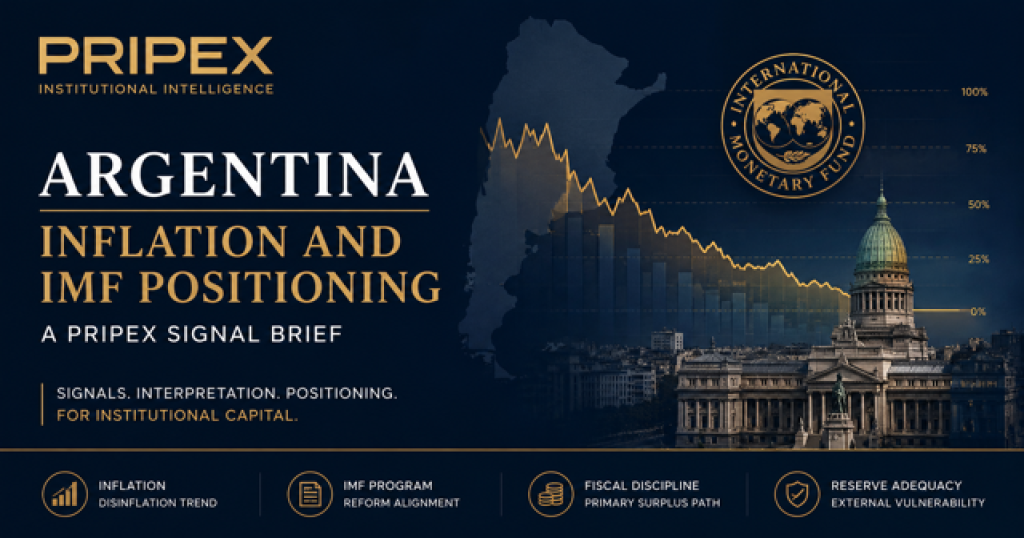
Argentina is moving through a high-stakes stabilization phase where inflation is falling from extreme levels, fiscal discipline has improved, and IMF support remains central to external credibility. The signal is improving — but still fragile. PRIPEX interprets Argentina as a conditional stabilization case under IMF-supported credibility reconstruction.
Table of contents [Show]
A PRIPEX Signal Brief
Argentina is moving through a high-stakes stabilization phase where inflation is falling from extreme levels, fiscal discipline has improved, and IMF support remains central to external credibility. The signal is improving, but still fragile.
The IMF's recent approval of a further disbursement reinforces Argentina's reform momentum, but the Fund's own framing remains cautious: progress is visible, yet reserve accumulation, disinflation durability, and market access remain unresolved pressure points.
PRIPEX interprets Argentina as a conditional stabilization case under IMF-supported credibility reconstruction.
Argentina matters because it is not merely another inflation case. It is a recurring sovereign credibility test.
The country's challenge is not only to reduce inflation, but to prove that stabilization can survive:
For institutional capital, Argentina is therefore a test of whether reform momentum can become durable institutional credibility.
Argentina's current signal has four layers.
First, disinflation is real but incomplete. Inflation has fallen sharply from crisis levels, but IMF projections still place 2026 inflation at elevated levels by normal institutional standards.
Second, fiscal adjustment has improved credibility. Argentina's move toward primary surplus strengthens the reform signal and supports IMF engagement.
Third, reserve adequacy remains a core vulnerability. IMF support helps, but reserve rebuilding is still a major test of whether external confidence can be sustained.
Fourth, the IMF relationship is both a stabilizer and a constraint. It supports credibility, but also highlights Argentina's dependence on external validation.
Argentina is no longer best read only as uncontrolled macroeconomic deterioration.
But it is not yet a normalized sovereign allocation environment.
PRIPEX currently classifies the signal as:
IMF-supported stabilization with unresolved inflation and reserve credibility risk.
Institutional capital is likely to remain selective until inflation expectations, reserve accumulation, fiscal execution, and market access improve together.
| Metric | Trend | Status |
|---|---|---|
| Inflation Trajectory | Down | Strengthening |
| IMF Program Alignment | Up | Strengthening |
| Fiscal Discipline | Up | Strengthening |
| Reserve Adequacy | Flat | Fragile |
| External Financing Access | Flat | Fragile |
| Currency Framework Credibility | Flat | Weakening |
| Market Confidence | Up | Stable |
| Execution Capacity | 🔒 Pro | Pro |
| Shock Absorption Capacity | 🔒 Pro | Pro |
| Political Sustainability Risk | 🔒 Pro | Pro |
PRIPEX is monitoring:
Argentina's stabilization effort is credible enough to re-enter institutional monitoring frameworks, but not yet durable enough to be treated as normalized.
The strongest signal is fiscal and IMF-aligned reform momentum.
The weakest signal remains the combination of reserve vulnerability, inflation persistence, and political sustainability risk.
The objective is not to predict Argentina's next IMF review. The objective is to assess whether Argentina is converting external support into internal credibility.
View Methodology | Explore Signal Briefs | Access PRIPEX Pro
This material is provided for institutional intelligence and informational purposes only. It does not constitute investment advice, financial promotion, legal advice, or solicitation to buy or sell any security or financial instrument. PRIPEX assesses structural signals, institutional behavior, and positioning dynamics under uncertainty. All interpretations remain conditional and subject to change as new information emerges.

What federal friction is—and is not—changing for capital, energy and long-duration decisions
Nigeria has moved from conditional FX stability into substantive market normalization. What remains conditional is the durability, depth and accessibility of that stability under stress.