Alberta's Referendum Is Testing Canada's Institutional Bargain
What federal friction is—and is not—changing for capital, energy and long-duration decisions


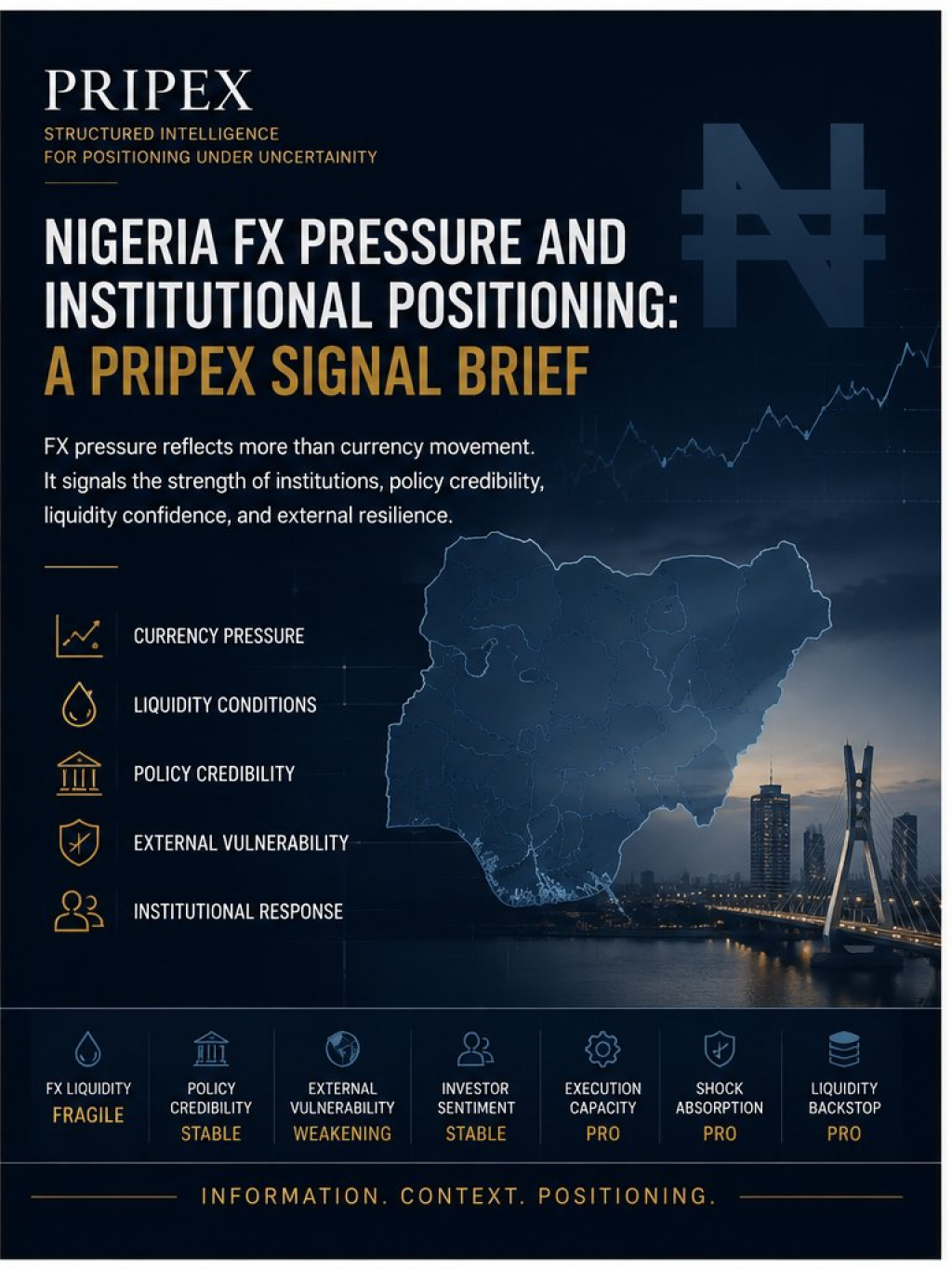
PRIPEX assesses Nigeria's FX pressure as a structural positioning signal — linked to liquidity conditions, policy credibility, institutional response capacity, and external vulnerability.
Nigeria's foreign exchange pressure is a structural positioning signal, not a cyclical technical event. It reflects the interaction between liquidity architecture, policy credibility, institutional response capacity, and external vulnerability — and requires structural intelligence to assess accurately.
Table of contents [Show]
Nigeria's FX system remains under sustained structural pressure driven by multiple overlapping factors: a structural dependency on oil revenue for FX supply, incomplete exchange rate liberalisation creating residual price distortions, reserve adequacy constraints limiting CBN intervention capacity, and portfolio capital flow volatility tied to global risk appetite and domestic yield dynamics.
These are not temporary imbalances correctable through short-term intervention. They reflect structural positioning risk that allocators must assess and calibrate over medium to longer horizons.
Nigeria's FX liquidity remains externally anchored — dependent on oil export receipts and short-term capital flows. The absence of a diversified FX supply base creates systemic exposure to commodity cycles and global risk shifts.
CBN policy has oscillated between administrative control and market liberalisation. The current direction favours liberalisation, but institutional credibility remains constrained by historical policy reversals and limited anchoring of reform commitments. Policy direction is constructive; policy credibility is still being established.
Nigeria's institutional architecture for FX management — including the CBN, fiscal authorities, and financial sector supervisors — has demonstrated adaptive capacity under stress, but structural coordination gaps remain. Response capacity exists; coordination depth is limited.
Nigeria's external accounts remain structurally exposed to oil price movements, global liquidity cycles, and portfolio flow reversals. Reserve adequacy provides a limited buffer against sustained external shocks.
For institutional allocators, the Nigeria FX environment creates distinct positioning considerations. Entry conditions are structurally dependent on policy credibility continuation and oil market stability. Exit conditions are more constrained than entry pricing suggests — liquidity risk is asymmetric. Duration exposure carries elevated structural risk relative to headline yield. Hedging costs embed a structural fragility premium that reduces net positioning returns.
The structural case for Nigeria requires reform progress at the institutional level — not simply favourable short-term market signals.
Current signal classification: Conditional Stability — Elevated Structural Risk
This classification reflects improved surface-level stability relative to the acute stress period, persistent structural vulnerabilities limiting the depth of stabilisation, and the conditional nature of the current equilibrium — dependent on sustained capital inflows and policy consistency.
Assessment date: May 2026. Canonical scorecard reflects PRIPEX structural assessment based on publicly available indicators and governed methodology.
| Metric | Trend | Status |
|---|---|---|
| FX Pressure | → flat | Weakening |
| Reserve Confidence | → flat | Stable |
| Inflation Pass-Through | ↑ up | Weakening |
| Investor Confidence | → flat | Stable |
| Policy Credibility | → flat | Stable |
| External Vulnerability | ↑ up | Weakening |
| Liquidity Conditions | → flat | Weakening |
| Execution Capacity | → flat | Pro |
| Shock Absorption Capacity | → flat | Pro |
| FX Liquidity Backstop | → flat | Pro |
Nigeria's FX environment presents a structurally fragile but conditionally stable signal. The system has moved beyond acute crisis, but stabilisation remains externally dependent — contingent on capital inflow continuity, oil market support, and consistent policy execution. Allocators with Nigeria exposure must price this conditionality into duration, entry, and exit assumptions. The three Pro metrics capture dimensions of institutional response and liquidity support that carry material implications for positioning under stress scenarios.
PRIPEX ProAccess
For deeper PRIPEX analysis of Nigeria's FX pressure, institutional positioning, and structural vulnerability indicators, unlock the expanded report or subscribe to PRIPEX Pro.
Unlock Full Report Access | Subscribe to PRIPEX Pro | Request Custom Intelligence Review
Disclaimer Note: PRIPEX content is informational and analytical in nature. It does not constitute investment advice, financial advice, legal advice, tax advice, or any form of regulated professional guidance. Users remain responsible for their own independent decisions.

What federal friction is—and is not—changing for capital, energy and long-duration decisions
Nigeria has moved from conditional FX stability into substantive market normalization. What remains conditional is the durability, depth and accessibility of that stability under stress.