Alberta's Referendum Is Testing Canada's Institutional Bargain
What federal friction is—and is not—changing for capital, energy and long-duration decisions


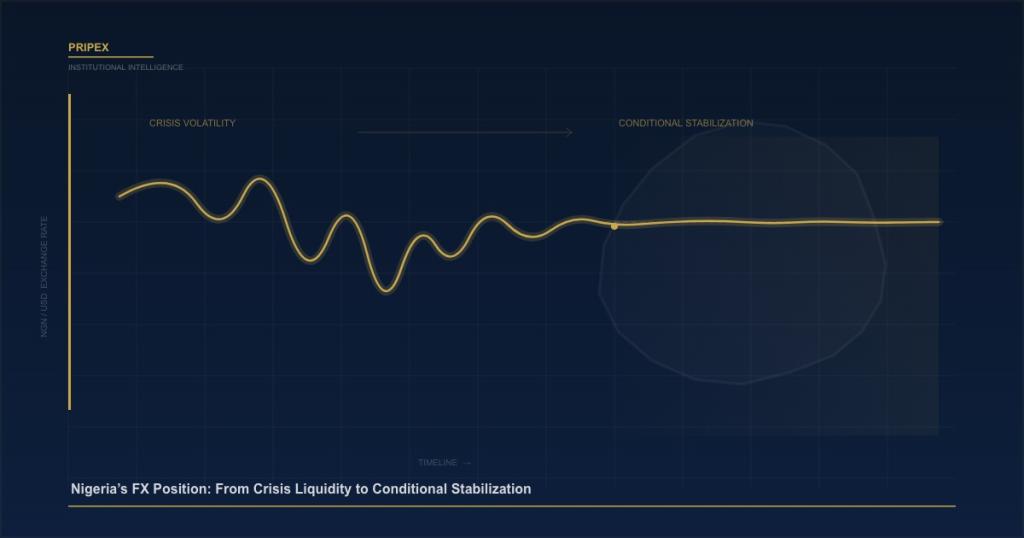
Nigeria’s FX system is shifting from crisis-driven liquidity management to a more flexible but externally dependent equilibrium, where stability is increasingly conditioned on capital flows and policy credibility rather than administrative control.
Nigeria's FX position has moved from acute dysfunction toward conditional stabilisation — but this equilibrium is not internally generated. It remains externally dependent on sustained capital inflows, policy consistency, and confidence maintenance, making structural positioning risk materially different from headline market signals.
Table of contents [Show]
Nigeria's foreign exchange system has transitioned from acute liquidity stress toward a more managed stabilisation phase. This shift reflects recent policy adjustments by the Central Bank of Nigeria (CBN), including exchange rate unification efforts, reduced direct intervention, and renewed attempts to attract external capital.
However, the system remains structurally sensitive to oil revenue volatility, capital flow dynamics, and confidence in monetary governance. The current state is best understood not as recovery, but as conditional stabilisation.
The FX system is shifting from a tightly controlled regime under stress to a more flexible but externally dependent structure. Liquidity conditions have improved relative to crisis levels, but stabilisation is not internally generated. It is contingent on sustained policy credibility and continued capital inflows.
Exchange rate convergence reflects improved price discovery, but also signals reduced capacity to sustain artificial rate differentials. The system now exhibits reflexive stability: confidence supports inflows, inflows support stability, and stability reinforces confidence. This loop is inherently fragile.
Reserve adequacy remains a binding constraint, limiting the central bank's ability to absorb external shocks. While backlog reduction signals operational progress, it does not fully resolve accumulated trust deficits among foreign investors and corporate participants.
Scenario 1 — Conditional Stabilisation (Base Case): Sustained inflows and policy consistency maintain FX liquidity within a narrower band.
Scenario 2 — Flow Reversal: A decline in portfolio inflows or external shocks (e.g., oil price decline) reintroduces liquidity stress and widens FX spreads.
Scenario 3 — Policy Reversion: Rising inflation or political pressure triggers a return to administrative controls, disrupting current stabilisation dynamics.
Scenario 4 — Gradual Structural Strengthening: Continued reform in FX transparency and fiscal coordination reduces reliance on short-term capital flows over time.
Assessment date: May 2026. Canonical scorecard reflects PRIPEX structural assessment based on publicly available indicators and governed methodology.
| Metric | Trend | Status |
|---|---|---|
| FX Liquidity | ↑ up | Strengthening |
| Naira Stability | → flat | Stable |
| Reserve Confidence | → flat | Stable |
| Market Confidence | ↑ up | Strengthening |
| Inflation Pass-Through | ↑ up | Weakening |
| External Vulnerability | → flat | Weakening |
| Reform Credibility | → flat | Stable |
| Execution Capacity | → flat | Pro |
| Shock Absorption Capacity | → flat | Pro |
| FX Liquidity Backstop | → flat | Pro |
Nigeria's FX position has moved from acute dysfunction toward a more stable but conditional equilibrium. The most important shift is not simply the narrowing of FX spreads, but the transition toward a more flexible and less administratively constrained market structure. However, this stability is not yet structurally embedded. It remains dependent on sustained capital inflows, policy consistency, and confidence maintenance. The central uncertainty is whether Nigeria can maintain this equilibrium under external or domestic stress — or whether the system will revert to administrative controls when tested. The three Pro metrics capture execution depth, shock absorption, and liquidity backstop dimensions that are critical for institutional positioning decisions.
PRIPEX ProAccess
For deeper PRIPEX analysis of Nigeria's FX stabilisation dynamics, institutional positioning risk, and structural scenario modelling, unlock the expanded report or subscribe to PRIPEX Pro.
Unlock Full Report Access | Subscribe to PRIPEX Pro | Request Custom Intelligence Review
Disclaimer Note: PRIPEX content is informational and analytical in nature. It does not constitute investment advice, financial advice, legal advice, tax advice, or any form of regulated professional guidance. Users remain responsible for their own independent decisions.

What federal friction is—and is not—changing for capital, energy and long-duration decisions
Nigeria has moved from conditional FX stability into substantive market normalization. What remains conditional is the durability, depth and accessibility of that stability under stress.